.png)
Work-oriented social work intervention
A successful treatment plan is about more than just symptom reduction. It is also about creating the best possible conditions for a secure and sustainable return to work with support from specialized social workers.







Returning to work often requires more than just treatment
For many people, the goal of treatment is not just fewer symptoms.
The goal is also to be able to return to work in a way that is realistic, sustainable, and takes into account your health, work life, and future opportunities.
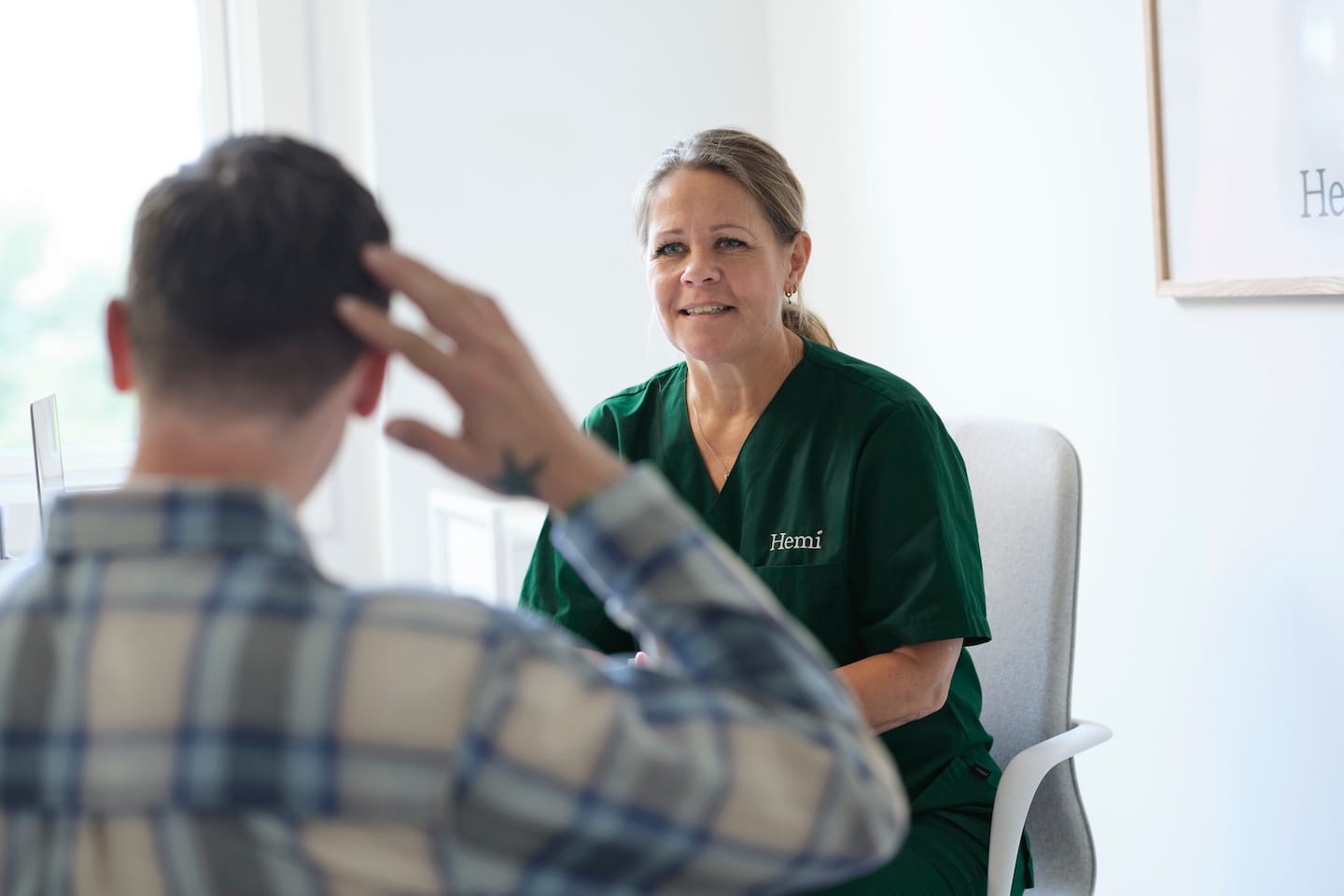
At Hemi, the work-oriented social work intervention is an integrated part of the treatment. Our social workers help translate health-related progress into a concrete plan for returning to work, ensuring that the patient, employer, and insurance company are all working toward the same goal.
Who can benefit from the intervention?
The work-oriented social work intervention may be relevant for people who:

Are fully or partially on sick leave
Need support to return to work
Uncertain about work capacity or workload
Need a gradual return-to-work plan
Need advice on workplace accommodations
Need support in the dialogue with employer, insurance, or local authorities
Need help creating a sustainable everyday life at work

Why companies and insurance providers choose Hemi
At Hemi, companies and insurance providers receive a specialized, interdisciplinary intervention focused on the patient's function and work capacity.

Interdisciplinary assessment
The work-oriented intervention is based on a comprehensive assessment from relevant specialists.

Focus on work capacity
We focus purposefully on developing function and work capacity, rather than just reducing symptoms.

One unified plan
The patient, employer, and insurance company all work from the same plan and the same goals.

Specialized target group
Extensive experience with migraines, headaches, concussions, whiplash, and other complex pain conditions.
Focus on work capacity rather than sick leave
Being on sick leave is rarely a goal in itself.
The goal is to create the best possible conditions for the patient to utilize their professional potential in a way that is realistic and sustainable.
That is why our social workers focus on possibilities rather than limitations, helping the patient gradually rebuild their work capacity.
.jpg)
Anna Løfqvist, co-founder


Part of a comprehensive treatment plan
At Hemi, our social workers work closely with physiotherapists, pain therapists, neuropsychologists, nurses, and neurologists.
This means that recommendations for returning to work are based on a comprehensive clinical assessment rather than a single professional perspective.
The goal is a single, unified plan where treatment, work life, and workload support one another.

Anna Løfqvist, Co-founder
Collaboration with employers and insurance companies
Our work-focused social services intervention often involves dialogue with employers, insurance companies, and other relevant stakeholders.
We provide a clinically grounded assessment of functional capacity, work ability, and relevant accommodations, as well as guidance on a realistic plan for returning to work.
The goal is to create a shared basis for decision-making that supports both the patient's health and a sustainable return to work.

Anna Løfqvist, Co-founder
Kind words from our clients
Patient experiences speak for themselves – here they share their stories.
"It was a huge help that I could get an appointment within the same week and didn't need a referral. All in all, my experience at Hemi was absolutely fantastic, and my meeting with the specialist was both very personal and professional."

"I was in safe hands with specialists who truly understood my situation. The digital solution meant that help was always within reach."

"Receiving treatment online has worked surprisingly well. It has been optimal to be able to sit at home and avoid both waiting time and driving back and forth. Especially on days when my head feels heavy."

"In just a few months, my quality of life has improved significantly. Through my conversations with the headache nurse, I have become more aware of my own thought patterns and the fear I have of the next migraine attack."

Frequently asked questions
No. The initiative may also be relevant for people who are still working but need support to adapt work tasks, working hours or workload.
No. The work-oriented social work effort can be included in treatment courses across the disease areas that Hemi treats when the disease affects work ability or return to work.
Yes, when the patient wishes. The social worker can contribute with advice, meeting attendance and coordination, so that all relevant parties work from the same plan.
Ready to take the next step?
Whether you are a patient, an employer, or represent an insurance company, we are happy to help assess how a work-oriented social intervention can support a treatment plan.


Ring og book en tid på
Åbent Mandag - Fredag 9-15
Eller skriv en mail til